Exile and the impossibility of return
The Glass RoomExile and the impossibility of return is the novel’s movement from imagined temporary absence to an irreversible break with home. For Liesel, exile first takes the shape of a departure she expects to undo; its deeper force emerges when familiar life is no longer waiting to be resumed, and when borders make belonging a matter of papers and official discretion.
Borders and the Meaning of Freedom
When Rainer von Abt returns from Vienna, he describes the journey as pleasant because he anticipated seeing Liesel and Viktor, but complains that passport control at the border is ridiculous: a new control has appeared where none existed before. Liesel’s answer treats this as a small loss of freedom weighed against freedoms gained. Rainer turns the exchange back toward her, asking whether she is free. The conversation makes movement across borders more than a practical inconvenience: the new checkpoint exposes how claims of progress can coexist with a diminished ability to travel, while personal freedom remains unsettled rather than guaranteed.
A later exchange between Viktor and Kata echoes the same uncertainty on an intimate scale. Viktor says that their arrangement allowed her to stop seeing men, including him, but admits that things between them seemed different. Kata acknowledges that she missed him despite not wanting to, then warns that distance must be maintained. The scene does not equate private attachment with political exile, but it places separation and the effort to regulate it alongside the novel’s wider concern with freedoms that are conditional, negotiated, and vulnerable to events.
Departure and the Lost Home
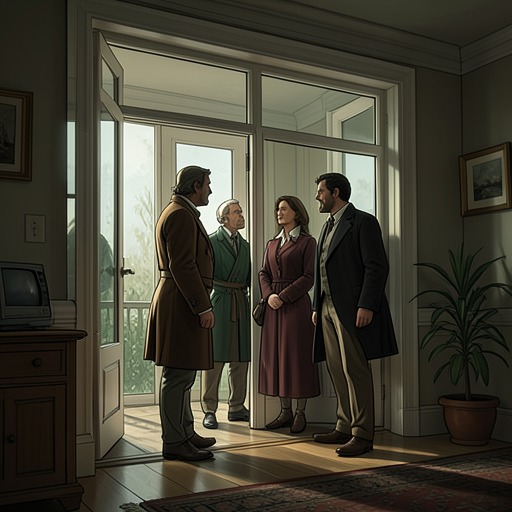
Before leaving, Liesel stands looking at the Glass Room. Rain blurs the windows, and the narration connects that distorted view to the way memory changes with time and mood. The house is a place of reason, yet she feels the anguish of departure and the pain of remembering. The departure becomes concrete soon afterward: on a Friday, the seventeenth, a convoy leaves the house down Blackfield Road. Viktor and Liesel travel with the children in the first car; Kata follows with Marika and the luggage, while Oskar and Hana bring up the rear. New road regulations have taken effect, and the nearly empty streets make the journey feel estranged from ordinary life. The family is not simply changing addresses; it is crossing into a world whose rules have already changed.
In exile, the family settles into a villa that resembles a small castle, with a turret, crenellations, and a door built to withstand a siege. Viktor calls it a monstrosity in the Wagnerian style. Amid its heavy furnishings, the family feels like raiders camping in abandoned enemy ruins. The villa may shelter them, but its appearance and atmosphere deny the comfort of home: they occupy it without belonging to it.
Liesel initially tells herself that the stay is temporary and that they will soon return. She tries to imagine their circumstances as a holiday in a rented lakeside villa, with local excursions, sailing, feeding ducks, and walks in the hills. But the comparison fails because a holiday has a known ending and leads back to the life briefly suspended. Exile has ended that life. A new one must be assembled from the limited pieces available: the house, garden, lake and mountains, and three adults with three children. The image of six characters searching for a home captures both the family’s physical displacement and the incompleteness of its new domestic world.
The Hope of Return
Liesel continues to voice the possibility of going home. In conversation with Kata, she suggests they may be back before Christmas and that matters may settle down. The younger woman answers that they cannot go back, only forward. Liesel laughs without humour and observes that they sound like characters from Chekhov; Kata does not know who Chekhov is. The brief mismatch leaves the exchange grounded in their differing frames of reference, while its central disagreement remains stark: for Liesel, return is still a spoken possibility; for Kata, the direction of life has already become irreversible.
Liesel writes from her bedroom desk with the lake in view, addressing people who exist for her only in memory: her mother, a favourite aunt, a school friend of Benno’s, and Hana. Writing gives exile a form, but it also reveals the distance it cannot overcome. Her correspondent’s consoling claim that the finest parts of German culture are being preserved does not restore the world Liesel has left. The remembered people and the absent Hana belong to a life that can now be reached through recollection and letters, not by simply going home.
Documents, Discretion, and Separation
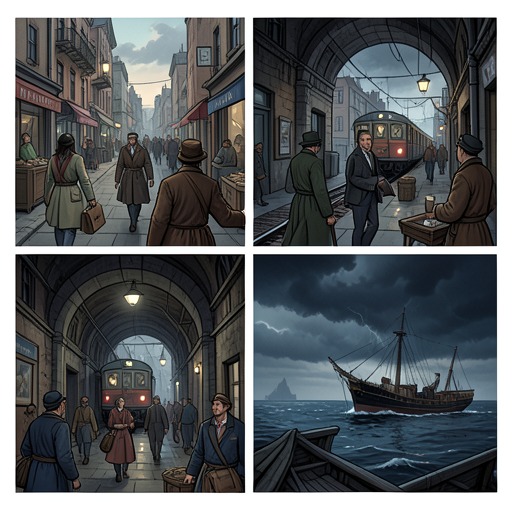
The border’s power becomes immediate when officials inspect the family’s documents. A stout, middle-aged man in a uniform marked Feldgendarmerie demands papers from Viktor. Viktor arranges the documents in neat piles and identifies the group: himself, his wife, their two children, the children’s nanny, and her daughter. Passports and French transit and Spanish visas are examined; the official then demands tickets. The orderly display gives the scene the appearance of a test that paperwork might settle, but the narration likens the tickets to a winning hand in poker and stresses that victory is not assured.
The apparent completeness of the papers does not protect Kata. When the official examines her passport and visas, he rebukes Viktor for speaking on her behalf and calls over another official. After their consultation, a uniformed figure takes Kata by the elbow and leads her toward a hut. Marika cries out for her mother, and Liesel pulls the child close, promising that she is safe and that the family will look after her. The separation unfolds rapidly, turning a document check into a direct threat to the family’s unity.
Kata and Marika are then led toward the hut together. Viktor protests that Kata’s papers are in order and that she is travelling on a Nansen passport; he points out that the same documentation was accepted when they left Czechoslovakia and was valid for entry into France and Spain. The official warns him to return to the train or risk detention, then advises him to move on and wait, suggesting that the delay may be temporary. The crowd presses forward, eager not to become the next unlucky case. The episode leaves return and refuge unresolved: papers can establish a claim, but they cannot compel officials to honour it, and the family must board while Kata and Marika remain in the authorities’ hands. Exile is therefore not only distance from home; it is dependence on systems that can interrupt movement, separate companions, and make even a temporary passage uncertain.